
From Survival to Truth

I no longer shrink myself to fit his version of the story.

He told me he hopes I don’t get in trouble for “lying” to the domestic violence program. In his mind, because he didn’t hit me, there was no abuse. That’s what he clings to. That’s what he throws back at me, as if the absence of bruises erases the years of damage.

But I know better now. Abuse isn’t just a fist. Abuse is the way he controlled the money, the way he isolated me, the way he made me question my own sanity until I couldn’t tell which way was up. It’s the fear that lived in my chest, the shame that kept me quiet, the constant shrinking of myself just to keep the peace.

People don’t see those wounds. They see me standing, functioning, surviving, and they think maybe it wasn’t that bad. Some even question me to my face, or worse, behind my back. But those unseen scars follow me into every part of my life. They shape the way I make decisions, the way I trust (or don’t trust), the way I still fight to believe I’m enough.

So no, I didn’t lie when I asked for help. I told the truth of my experience, even when it felt small compared to what others survived. I told the truth of years lived in survival mode. And asking for support wasn’t deceit, it was survival. It still is.

I didn’t lie to survive. 

I survived to finally tell the truth.

I Am Worthy

Things No One Said

I became a widow in the dark.

Weeks earlier, I had finally moved out of the FEMA trailer.

It wasn’t a fresh start. It was just another chapter in survival.

No one pulled me to the side and said,

“Are you okay?”

“You don’t have to figure this out alone.”

I made a new partner in the dark, in 2013.

Not with intention, but in response to the weight I was carrying.

One moment of unmatched intimacy, and the direction of my life shifted again.

But not once did someone say,

“Let’s talk.”

“I’ll walk with you through this.”

“I’ll help you see clearly when the world feels blurry.”

No one said,

“You’ve been through enough.”

“You don’t owe anyone your performance of being okay.”

I had a friend who got a luxury car.

She called her friends from the dealership, hype in her voice.

I showed up. In the dark.

I was already behind on what I drove to that lot.

And still, I traded it in.

Left with another debt—26% interest.

No one pulled me aside and asked,

“Why are you doing this?”

“What are you trying to fill?”

People looked at the survivor’s benefits I received for my children and assumed I had it good.

But they didn’t see what it was costing me to stay afloat.

What I was carrying.

What I was trying to unlearn.

It’s taken years for me to admit this:

I didn’t know how to not struggle.

Even when things got better, I’d wait for the ground to drop.

Because that’s what I’d been taught—by experience, not words.

I wonder sometimes—if people from my past ever think about the version of me they encountered.

The one trying to hold it all together.

The one doing what she thought she had to.

The one who needed guidance, not judgment.

Presence, not praise.

There’s so much I wish someone had said.

But now I’m learning how to say it to myself.

And maybe, someone reading this will remember the silence they left behind.

And do better next time—with their sister, their friend, their coworker,

Or the version of themselves they’re still trying to forgive.

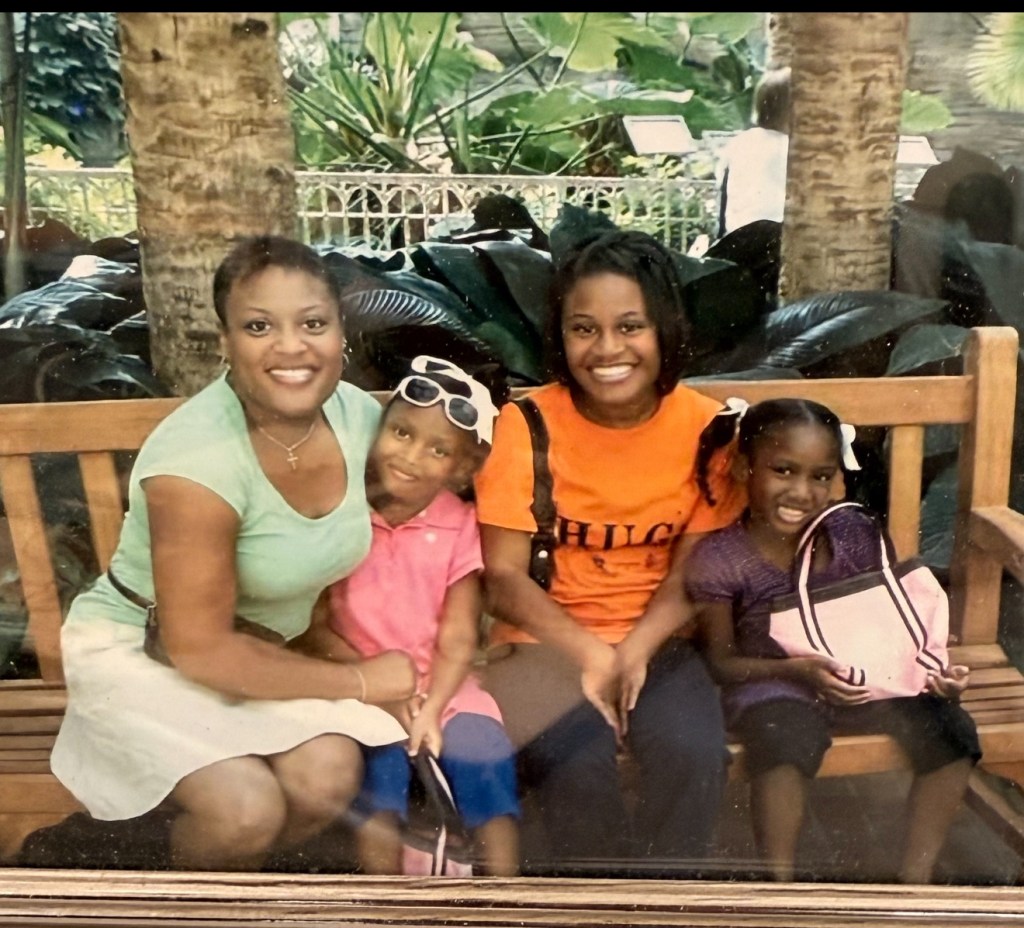
Summer 2008, flew my girls to Disney World. Today, I still wear that Coach Fanny pack. Alex still keeps her hair in a bun, Eb keeps tshirts on, and Syd still carries a tote.

If this stirred something in you, let it move you into action.

Be the one who checks in.

The one who sits beside someone in the dark, even if you don’t have the answers.

The one who says, “Let’s talk.”

“I see you.”

“You don’t have to do this alone.”

You don’t need to fix anyone.

But you can choose to show up.

That alone can change a life.